
Summer Vege Bag - Week 12
Click on any vegetable that has a link to see previous posts with recipes and cooking tips. You can also browse and filter the whole vege bag archive by vegetable here.
Please bring 2x containers this week
This week we have:
Carrots (Ahoaho māra kai)
6x Cucumbers and or Zucchini (Ahoaho māra kai & Crooked Vege Ōtaki)
Zucchini (Ahoaho māra kai & Crooked Vege Ōtaki)
Salad Mix - fill your own (Crooked Vege Ōtaki)
Coriander (Ahoaho māra kai)
Pak Choi or Beetroot (Crooked Vege Ōtaki)
Microgreens - fill your own (Crooked Vege Ōtaki)
Tomatoes - heirloom (600-800g), cherry (300g), “regular” (600g) (Crooked Vege Ōtaki)
Vege highlights + suggested uses:
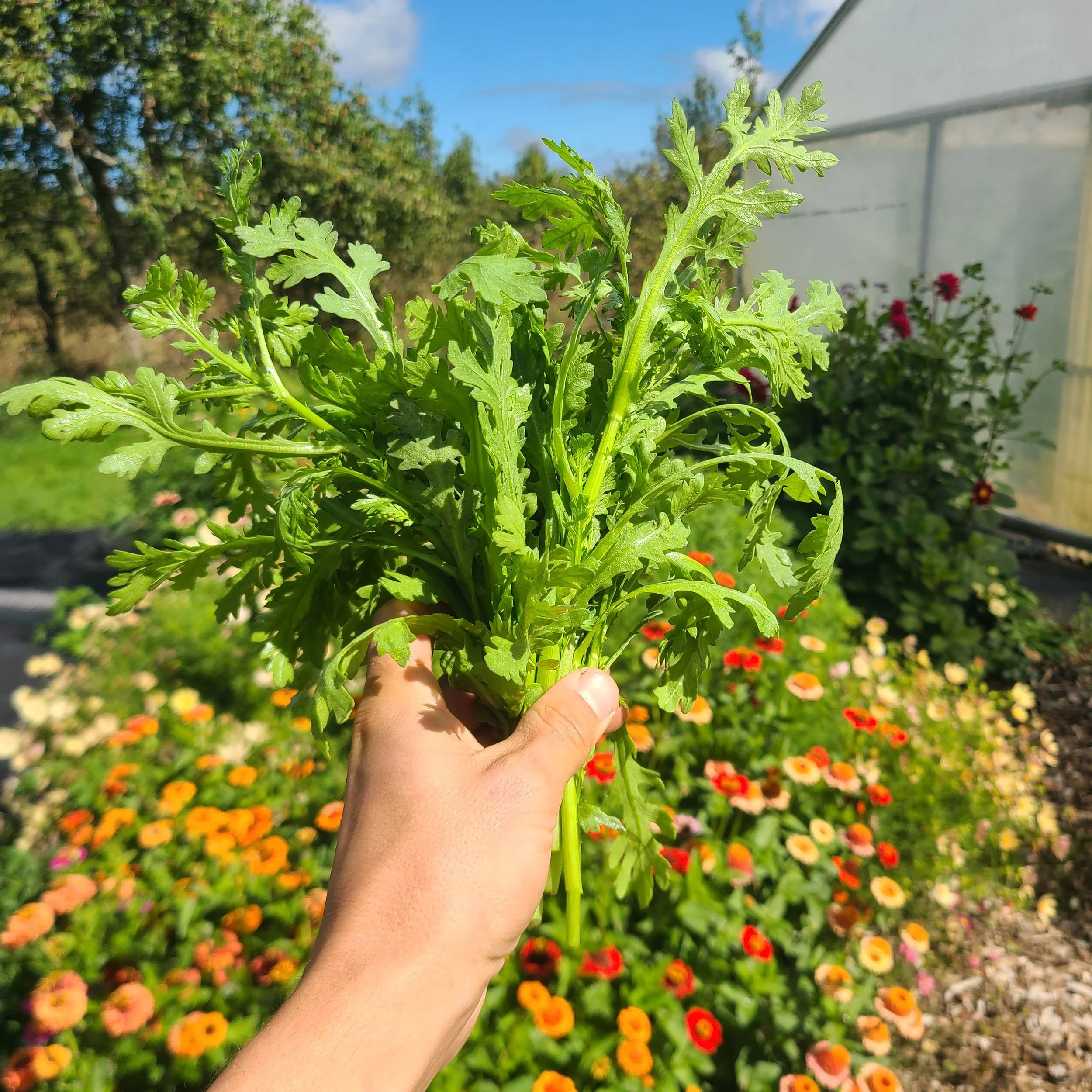
Shungiku
I was meant to write a couple of sentences about the varieties of heirloom tomatoes we grow. But it quickly became several paragraphs long ramble about heirloom vegetables and the double edged sword of industrial food systems.
And without any cooking suggestions. Oops. Scroll to the bottom if you’re interested.
(p.s. both varieties of heirloom tomato are excellent cookers!)
Shungiku
Another underappreciated vegetable that's one of our favourites!
If you've been around vege bags for a while, you'll have tried it before. If not, it's probably unfamiliar.
It's an edible chrysanthemum, also known as Tong Hao in mandarin. It's mild but unique flavour is popular in east Asian cooking.
It's great stir-fried or steamed - with other veges or on its own. Be careful not to overcook it (it can get bitter). I like to pan fry it with garlic and serve it with soy, sesame seeds and a bit of chilli as a side dish.
Shungiku tempura (basically battered and fried) is pretty awesome too - George wrote more about it here, last year.
Heirloom tomatoes (and a general ramble about heirloom vegetables)
Heirloom vegetables are what they sound like - old varieties. We've lost a huge amount of genetic diversity in vegetables - somewhere around 80% - since our kai systems started industrialising in the last 100-150 years.
Modern plant breeding has improved yields (massively), disease resistance and pest resistance. And for those following the incoming relaxation on GMO legislation, GMOs will (at least partially) focus on pesticide and herbicide resistance (an obvious environmental catastrophe).
Modern plant breeding also focusses on the demands of complicated, globalised food supply chains. Which means produce has to store for a long time and travel HUGE distances without damage. The commodification of kai and increasing disconnect we have from our kai systems means that uniformity is also important - wonky and irregular sized carrots don't sell as well at the supermarket as the perfectly straight ones.
The latter points in particular (storability, uniformity and transportability) come at a major cost to flavour, texture and often nutritional value.
Modern tomatoes, for example, lack tetra-cis-lycopene (see this excellent write up from the Whangnui-based Heritage Food Crops).
A hyper-localised kai system, where vege-eaters are closely connected to vege-growers and the whenua, doesn't have the same pressures. We transport tomatoes a few kilometers to the vege bag pick up. They're picked the day before you get them (or sometimes the same morning, if we've been disorganised). They don't have to survive being trucked to Gore or flown to Glasgow, spending days in warehouses, moving between trucks, shaken around by forklifts, etc.
This also has the benefit of allowing us to pick 1-4 days ahead of peak ripeness - commercially tomatoes are picked earlier, so they can be transported while they are firm and less likely to bruise.
Complicated industrial supply chains need firm tomatoes to survive the rigours - which is why supermarket tomatoes are often pretty bland and "mealy."
So why don't we grow more heirloom varieties?
Modern varieties do generally have better yields, disease resistance and pest resistances. They're also bred for efficient management - modern tomatoes have easier to manage growth habits, and the "maintenance" cost of labour is lower. Some heirloom zucchini we've trialled have yielded 90% less than their modern counterparts. So higher labour costs, lower yield! It's hard enough to earn a wage as market gardeners, and obviously we can't increase the suggested price of Ōtaki Vege Bags 10x over.
But we do trial a few heirloom varieties each year - this season is edamame/soy, crown pumpkins and butternut squash trials. It’s a commitment to better kai, and a kai system and a slow step toward relying less on internationally owned seed companies. Varieties that yield close-enough to their modern counterparts and are able to command a better wholesale price (to offset the increase in labour + much higher risk of disease and pest problems), will make it into the crop plan the next season.
Heirloom tomatoes
Heirloom tomatoes are a rare example of an heirloom vegetable that does actually command a premium (have you ever seen "heirloom kale" at the organics shop?) that justifies the increased cost and risk. I checked the prices at 3 organic shops today, and they're retailing at $20/kg, $30/kg and $33/kg. We do have a niche, with a few shops and restaurants, that are willing to pay fairly for them - which also allows us to produce them for Ōtaki Vege Bags.
These varieties are Scoresby and Russian Persimmon.
Scoresby is a beefsteak that made its way from Australia to Aotearoa in the 1920s. It was grown by Watties until the 1960s. It's much tastier than any modern beefsteak we've trialled. This is our second year growing it.
I know less of the whakapapa of Russian Persimmon - but the seed came from another market gardener (and friend), Lux Organics in Rotorua. It's a large orange tomato, which Heritage Food Crops have done some research with. It’s my personal favourite!
Ka kite,
Jon
